

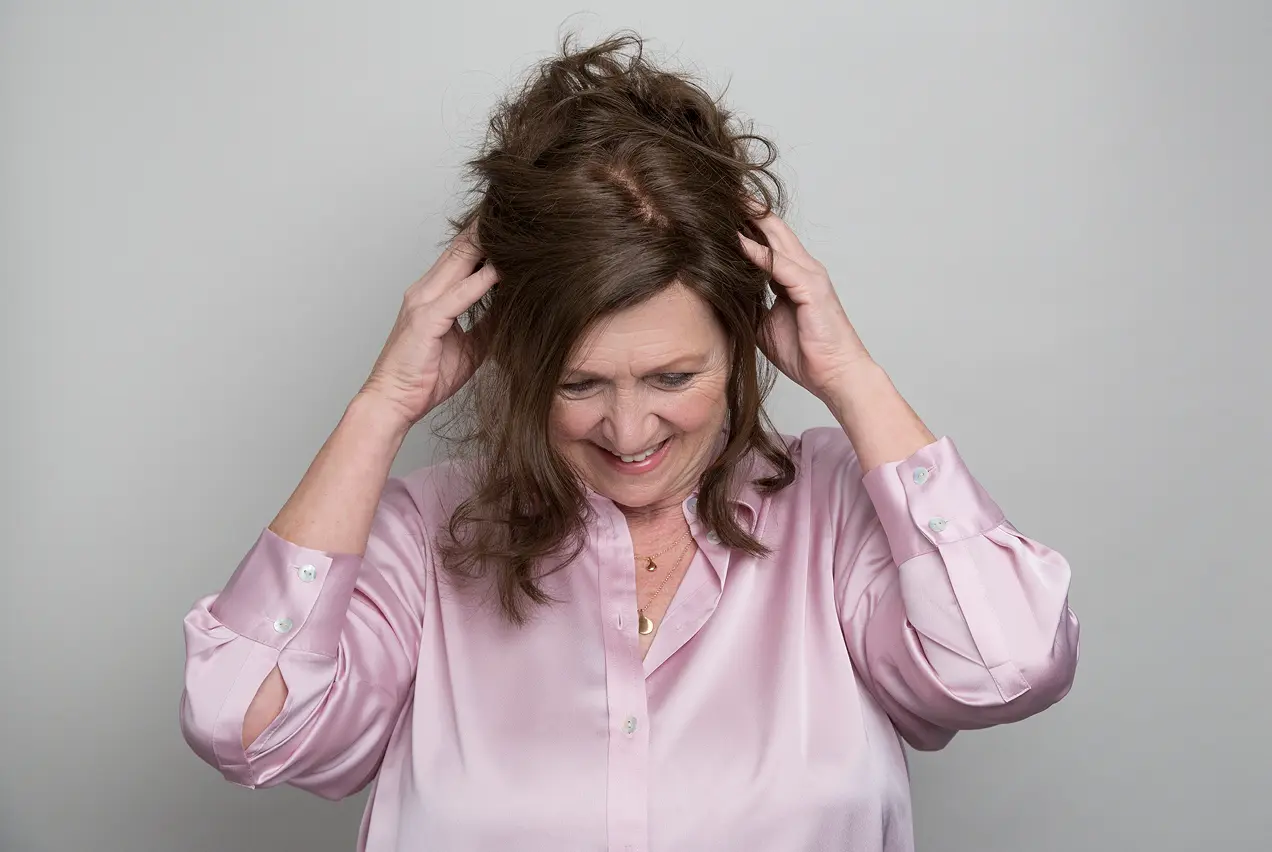
Hair thinning around the menopause is common, and for many women it is one of the most unsettling changes of the whole transition. Falling oestrogen and progesterone shorten the hair’s growth phase and leave some follicles more sensitive to androgens, so hair tends to become finer at the parting, crown and temples rather than falling out in patches. Medical treatment can slow it for some women but takes months to show results, which is why many choose a coverage option alongside it: a topper where there is still hair to blend with, a frontal hairpiece where the hairline has receded, or a wig where the thinning is more extensive.
Key points include:
- Why hormonal change affects hair growth and density
- The patterns menopausal hair loss usually follows
- Other causes worth ruling out with your GP
- When a receding hairline needs a dermatologist’s opinion
- What medical treatment can and cannot do
- Matching the coverage option to the type of thinning
- Looking after thinning hair day to day
- How a consultation helps you find the right solution
Many of the women who visit our studio in their forties and fifties begin with the same sentence: they thought it was just them. A ponytail that feels thinner, a parting that looks wider under the bathroom light, more hair in the brush than there used to be. Hair changes are one of the less talked about symptoms of the menopause, yet they are common, and understanding what is happening is the first step towards deciding what to do about it.
WHY THE MENOPAUSE AFFECTS YOUR HAIR
Every hair goes through a cycle of growing, resting and shedding. Oestrogen and progesterone help to keep hairs in the growing phase for longer, which is one reason many women notice thicker hair during pregnancy and heavier shedding afterwards. As both hormones fall through the perimenopause and menopause, the growth phase shortens and more hairs move into the resting and shedding stages at any one time.
At the same time, the balance between oestrogen and androgens (the hormones usually described as male, which women also produce) shifts. In follicles that are genetically sensitive to androgens, this can trigger a gradual process called miniaturisation: Each new hair grows back a little finer and shorter than the one before. The result is rarely dramatic shedding. It is a slow loss of density, which is why so many women only realise how much has changed when they see a photograph.
HOW MENOPAUSAL HAIR LOSS USUALLY SHOWS UP
Hormone-related thinning tends to follow a recognisable pattern. The parting widens, the crown becomes more visible and the hair at the temples and along the front can look sparser, while the back and sides often stay relatively full. Clinically this is usually described as female pattern hair loss, and the menopause is one of the points at which it most often becomes noticeable.
Texture often changes too. Hair can become drier, finer, frizzier or less willing to hold a style, and the arrival of grey adds a different texture to the mix. Some women also notice their eyebrows thinning. Losing hair from the face can be particularly hard, and we have written about why losing brows and lashes is more than cosmetic.
OTHER CAUSES WORTH RULING OUT
Not every change in midlife is down to the menopause, and it is worth seeing your GP before assuming it is. Thyroid problems, low iron stores and other nutritional deficiencies are all associated with hair loss and become more common in midlife. A period of illness, surgery or significant stress can trigger a temporary shedding known as telogen effluvium, which usually appears a few months after the event. Some medications also list hair thinning as a side effect.
A simple blood test can rule several of these out, and treating an underlying cause can make a real difference. Sudden shedding, patchy loss or a scalp that is itchy, sore or red should always be checked by a doctor rather than put down to hormones. If you would like to understand how the different conditions compare, our guide to the main types of alopecia and their causes is a useful starting point.
WHEN A RECEDING HAIRLINE NEEDS A CLOSER LOOK
Some recession at the front of the hairline is common after the menopause. One specific condition is worth knowing about, though: frontal fibrosing alopecia, usually shortened to FFA. It is a form of scarring alopecia that most often affects postmenopausal women and causes the hairline at the front and sides to move steadily backwards, frequently together with loss of the eyebrows. The skin where the hair used to grow may look paler and smoother than the rest of the forehead, and there can be redness around the remaining follicles.
Because FFA permanently damages the follicles it affects, early assessment by a dermatologist matters. Treatment aims to calm the inflammation and slow the recession rather than regrow what has already gone, so the sooner it is diagnosed, the more hair there is to protect. Where the hairline has already receded, Frontal Hairpieces can recreate it. Each one is handmade on a block shaped to the client’s own head and hair loss pattern, so it sits exactly where the natural hairline used to be.
WHAT MEDICAL TREATMENT CAN AND CANNOT DO
For hormone-related thinning, the medical options are worth discussing with your GP or a dermatologist. Some women find their hair improves on hormone replacement therapy, although HRT is prescribed for menopausal symptoms in general rather than as a hair loss treatment, and the effect varies from person to person. Topical minoxidil is widely used for female pattern hair loss and can slow thinning or improve density for some women, but it needs several months to show results and continued use to maintain them.
Treatment and coverage are not an either-or decision. Many of our clients wear a topper or wig while they wait to see whether a treatment works, and some keep wearing it afterwards simply because they like how it makes them feel. If you are weighing up longer-term routes, our comparison of wigs, hair transplants and medication sets out how they differ on results, cost and timescale.
CHOOSING A COVERAGE OPTION THAT MATCHES YOUR HAIR LOSS
The right option depends far more on where and how much hair has been lost than on your age or the cause. Starting with the least coverage that genuinely solves the problem usually gives the most natural result.
For thinning at the parting and crown, which is the most common pattern around the menopause, a hair topper is often the first choice. It adds density exactly where it is needed and blends with your own hair around it, so the overall look stays yours. If you are new to the idea, our explanation of what a hair topper is and our ultimate guide to hair toppers cover how they are matched and attached. Annemarie describes how a made-to-measure topper restored her natural curls and her confidence.
Where the thinning is concentrated at the front, fringe pieces offer a lighter alternative, while a frontal hairpiece rebuilds a hairline that has receded. Once thinning has spread across the top and sides, a half wig or full wig may give a more comfortable and consistent result than stretching a topper beyond what it can do. Our page on wigs for thinning hair explains how we approach each stage.
Full wigs come in several forms. A ReadyMade wig can be chosen, cut and styled in a single visit, a Made to Measure wig is built around your individual head shape, colour and density over around four months, and our Swish lace front wigs offer a ready to wear option at a wider range of price points. Whatever the style, the hair itself matters, and our guide to human hair vs synthetic wigs explains the difference in movement, styling and lifespan.
LOOKING AFTER THINNING HAIR DAY TO DAY
Small changes can protect the hair you have and make it look fuller in the meantime. Avoid tight ponytails, buns and heavy clips that put constant tension on the hairline, use a wide-toothed comb on wet hair and keep heat styling moderate. A good cut that removes weight and adds shape can make fine hair look noticeably thicker, and our tips for instant volume for thinning hair include several simple tricks worth trying.
The menopause often coincides with the decision about whether to keep colouring your hair. If you are thinking about letting it grow out, our piece on going for grey looks at how to do it with confidence, and silver and grey tones can be matched in a topper or wig as well. A common worry is that a hairpiece will make thinning worse. A well-fitted piece should not, and we explain why in Do Wigs Cause Hair Loss? The same reassurance applies to everyday wear, which is covered in our guide to how secure a wig really is.
HOW MANDEVILLE LONDON CAN HELP
We have spent more than 50 years making handmade wigs and hairpieces from fine European hair, and many of our clients come to us during or after the menopause. A consultation at our private Fulham studio is relaxed and unhurried: We look at your hair, talk through how it has changed and show you which options would genuinely suit you, with no pressure to decide on the day. Knowing what to expect from a wig consultation helps, as does looking through our price guide beforehand. When you are ready, you can book a complimentary consultation, and you are welcome to bring a friend or partner along for a second opinion.
FINAL THOUGHTS
Menopausal hair loss is common, it is not in your imagination and it is not something you simply have to accept. Start with your GP to rule out other causes and to talk through treatment, keep an eye on your hairline, and remember that there is a coverage option for every stage, from a discreet topper to a full wig. The aim throughout is the same: Hair that looks and feels like your own.
FREQUENTLY ASKED QUESTIONS (FAQ)
Does the menopause cause hair loss?
It can. Falling oestrogen and progesterone shorten the hair’s growth phase and can make some follicles more sensitive to androgens, which leads to gradual thinning, usually at the parting, crown and temples. It is a common symptom but not a universal one, and other causes such as thyroid problems or low iron should be ruled out.
Will my hair grow back after the menopause?
Shedding caused by a temporary trigger, such as illness or stress, often settles. Hormone-related thinning tends to be gradual and ongoing rather than reversing on its own, although treatment can slow it or improve density for some women, which is why speaking to your GP early is worthwhile.
Can HRT help with menopausal hair thinning?
Some women notice an improvement in their hair on HRT, but it is prescribed for menopausal symptoms in general rather than specifically for hair loss, and results vary. It is best discussed with your GP alongside your other symptoms.
How can I tell menopausal thinning from frontal fibrosing alopecia?
Menopausal thinning usually reduces density across the top of the head while the hairline stays in place. Frontal fibrosing alopecia causes the hairline itself to recede steadily, often with eyebrow loss and smooth, pale skin where hair used to grow. If you notice these signs, ask your GP about a dermatology referral.
Is a hair topper or a wig better for menopausal hair loss?
For thinning concentrated at the parting and crown, a topper is usually the most natural choice because it blends with your own hair. If the thinning has spread across most of the top and sides, a half wig or full wig often gives a more even and comfortable result.
Will wearing a topper make my thinning worse?
A correctly fitted topper should not. Problems tend to come from constant tension in the same spot, so the fit and attachment method matter, and both should be reviewed if your own hair changes.
Do I need a diagnosis before booking a consultation?
No. Many clients come to us while they are still investigating the cause of their hair loss. We would always encourage you to see your GP as well, but you can explore coverage options at any stage.
Latest blogs
Can You Get a Wig on the NHS? Prescriptions, VAT Relief and Funding Explained

Frontal Fibrosing Alopecia and a Receding Hairline: Hairpiece Options for Women
Wigs for Children and Teenagers: A Parent’s Guide to Hair Loss Support

Get the very nearest you can to having your own hair.
We will listen to your concerns, answer your questions and guide you through the process step by step to find the perfect solution that will work for you.